
The Complete Employer Guide to I-9 Audit Readiness in 2026
Learn how employers can prepare for I-9 audits in 2026, avoid penalties, and stay compliant with practical, audit-ready guidance.
.png)
Are you confident your I-9 process would hold up under scrutiny, or are you hoping it never gets audited? For many employers, I-9 compliance feels routine until it isn’t. A missed deadline, a missing signature, or an inconsistent process across locations can quickly turn into real financial exposure.
In 2023 alone, U.S. Immigration and Customs Enforcement (ICE) issued over $20 million in civil penalties related to I-9 violations, with the average fine per violation rising 34% since 2019.
What makes this risk more challenging to manage is scale. Remote hiring, high-volume onboarding, and decentralized teams have increased the likelihood of timing mistakes, inconsistent completion, and missing records. Most employers fined during audits believed they were “mostly compliant” until an inspection proved otherwise.
This guide is designed for employers who want clarity, not fear. It breaks down how I-9 audits actually work, where companies get exposed, and what audit readiness looks like in 2026.
What is an I-9 Audit?
An I-9 audit is a formal inspection of your Form I-9 records conducted by the ICE to verify that your organization properly documented work authorization for every employee hired in the U.S.
From experience, the most common audit exposure comes from operational issues, not legal edge cases such as missing or late forms, inconsistent completion across locations, and poor retention and retrieval practices.
For 2026, audit risk continues to rise because hiring is more distributed, onboarding is more decentralized, and tolerance for “administrative errors” remains low. Employers who treat I-9 compliance as a one-time hiring task rather than an ongoing operational process are most likely to fail an audit.
How an I-9 Audit Begins: Notices, Triggers, and Timelines
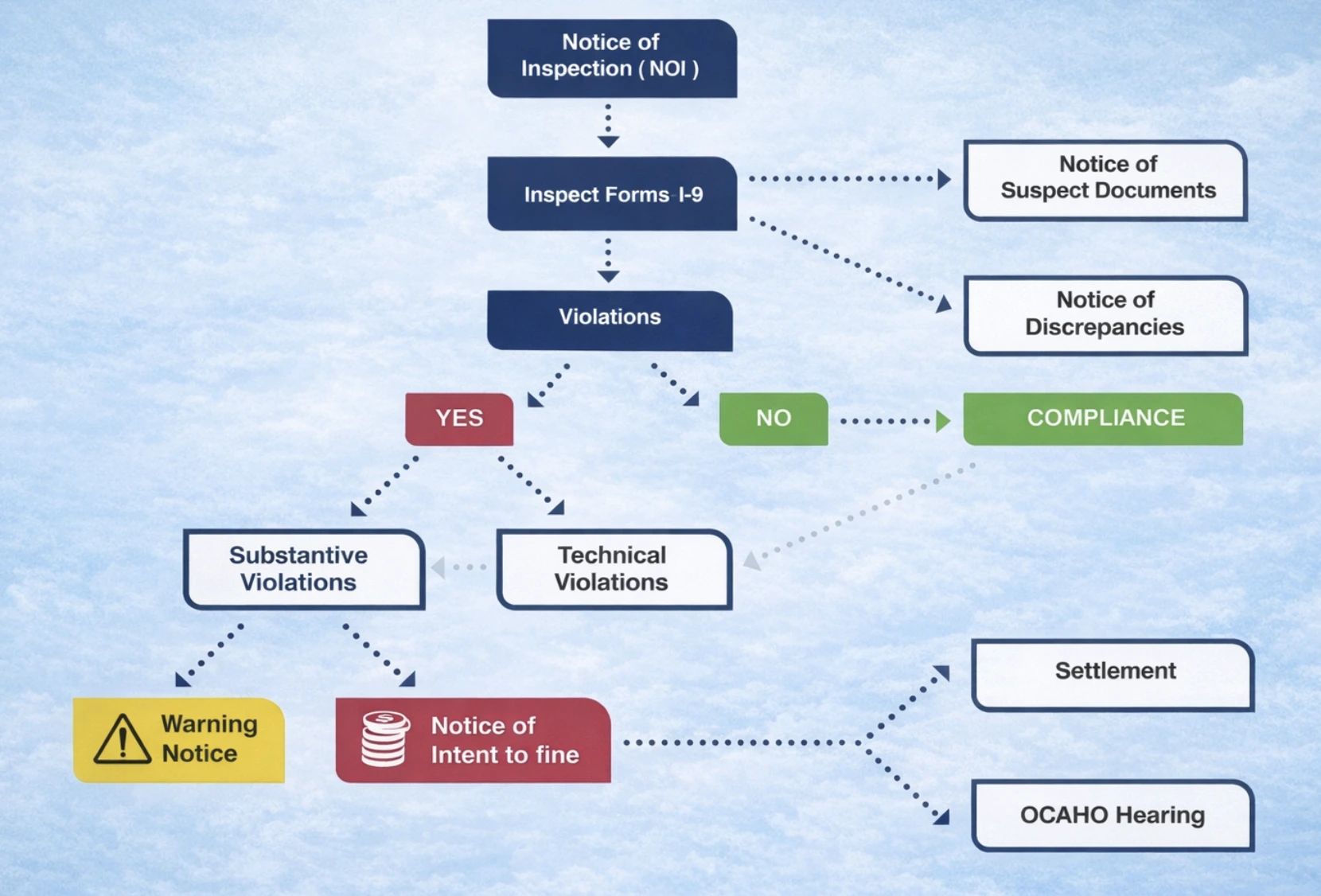
Most I-9 audits start the same way: your company receives a Notice of Inspection (NOI) from U.S. Immigration and Customs Enforcement. This notice formally requires you to produce your I-9 forms and related records for inspection.
Once the NOI is issued, employers typically have three business days to comply. Extensions are possible but not guaranteed, and they should never be assumed.
Common triggers that lead to an audit
ICE does not publish a definitive list of audit triggers, but in practice, audits most often follow:
- High-volume or rapid hiring periods
- Seasonal workforce spikes
- Multi-location or franchise-based hiring
- Complaints or tips (from former employees or competitors)
- Industry-wide enforcement initiatives
Importantly, audits are often random within targeted industries. Many employers with no prior violations are audited simply because their hiring profile fits an enforcement pattern.
What the initial request includes
The NOI usually requires employers to produce I-9 forms for current employees and terminated employees still within retention requirements along with payroll records and business identification documents.
ICE may also issue subpoenas or additional document requests if discrepancies appear during the initial review.
Why the timeline creates risk
Three business days is not much time if your I-9s are stored across multiple systems or locations, incomplete or inconsistently named, and mixed in with general personnel files.
In real audits, delays and missing records often lead to expanded scrutiny, even before ICE reviews form accuracy. Employers who cannot produce clean, complete records quickly tend to face deeper inspections and higher penalty exposure.
On-Site vs. Off-Site I-9 Audits: What Employers Should Expect
ICE conducts I-9 audits either off-site (document submission) or on-site (physical inspection at your location). The format determines how much control you have and how quickly issues escalate.
Off-site audits (most common)
In an off-site audit, employers submit Form I-9s and supporting records electronically or by mail for review at an ICE office. Once the documents leave your control, ICE reviews them without your team present, which means questions and errors do not surface incrementally.
Instead, issues appear all at once, often followed by additional document requests that widen the scope of the audit. This format exposes operational weaknesses quickly. Employers with decentralized storage, inconsistent file naming, or missing historical forms often struggle to respond accurately and on time.
In practice, penalties are frequently driven not by the severity of the errors, but by the employer’s inability to produce complete and organized records when asked.
On-site audits (higher disruption, higher risk)
In an on-site audit, ICE officers inspect records at your workplace. These audits are less common but more disruptive.
Employers should expect immediate access requests for I-9s and payroll records, direct interaction with managers or HR staff, and limited time to clarify or contextualize issues.
On-site audits increase risk when:
- Local managers completed I-9s inconsistently
- Forms are stored at multiple locations
- Staff are unsure how to respond to officer questions
From experience, on-site audits often follow prior compliance issues, complaints, or expanded investigations.
Audit-ready employers plan for both formats. They centralize records, standardize processes, and ensure any authorized staff can retrieve complete I-9s without delay.
What Auditors Review: Common I-9 Errors and Violations
During an I-9 audit, ICE reviews every required field on the form. Auditors do not focus on intent. They focus on accuracy, completeness, and timing. ICE classifies issues into two categories:
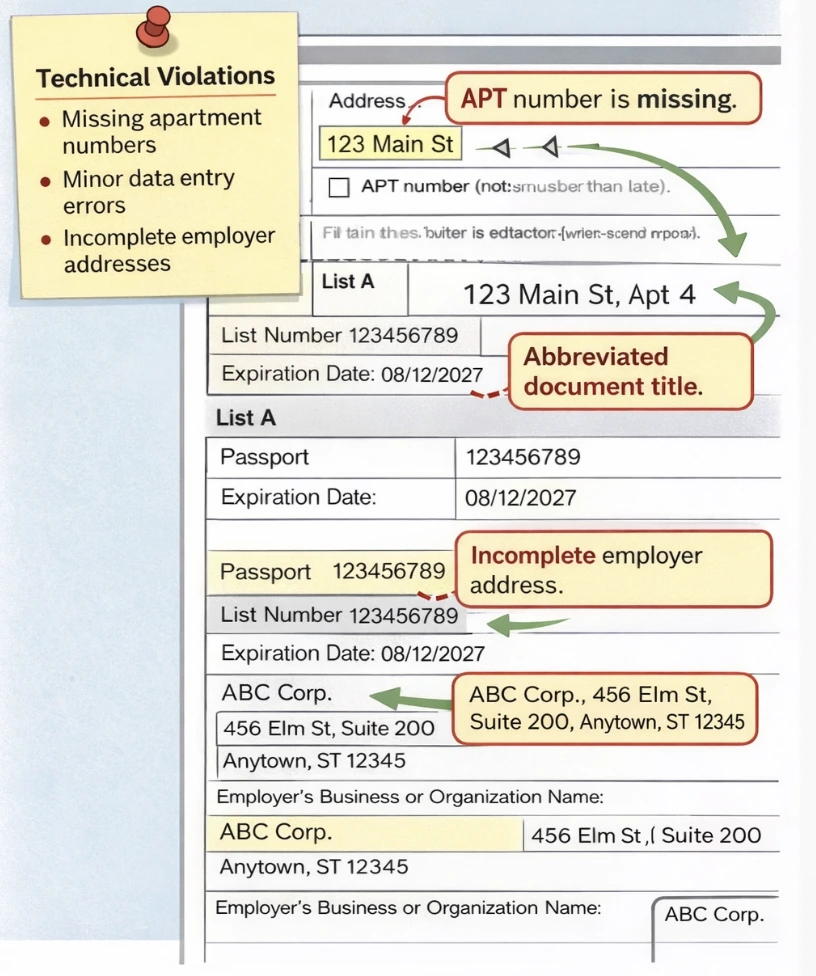
Technical violations (fixable but time-bound)
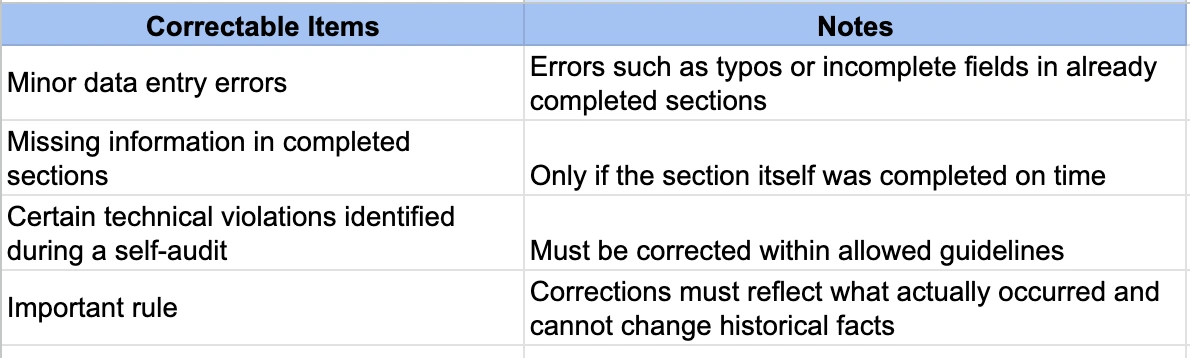
These are administrative errors that may be corrected if addressed promptly. Common examples include missing apartment numbers or minor data entry errors, abbreviated document titles, and incomplete employer addresses.
If ICE issues a Notice of Technical or Procedural Failures, employers usually have 10 business days to correct these errors. Miss that window, and the violations become substantive.
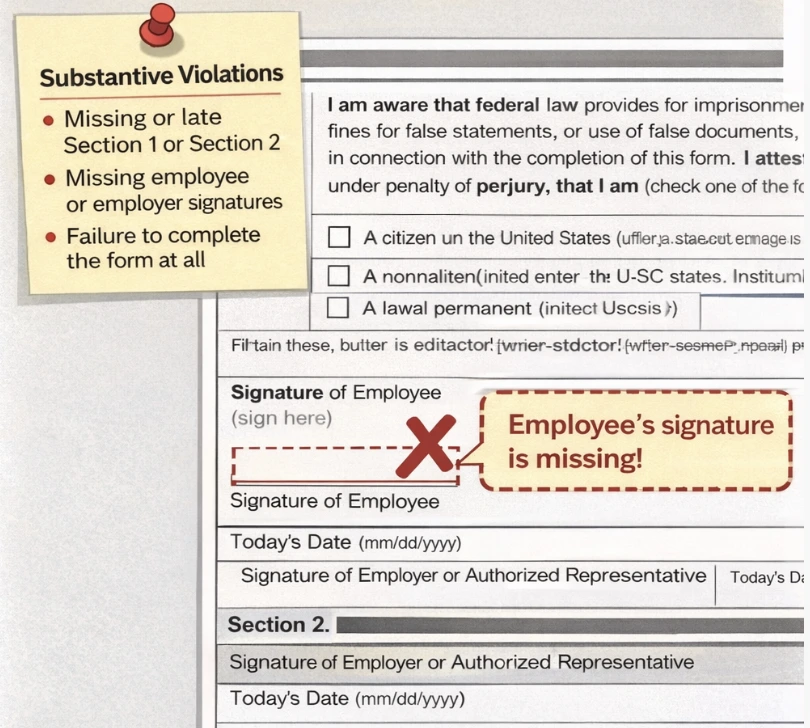
Substantive violations (penalty-triggering)
These errors cannot be corrected after the fact. They include:
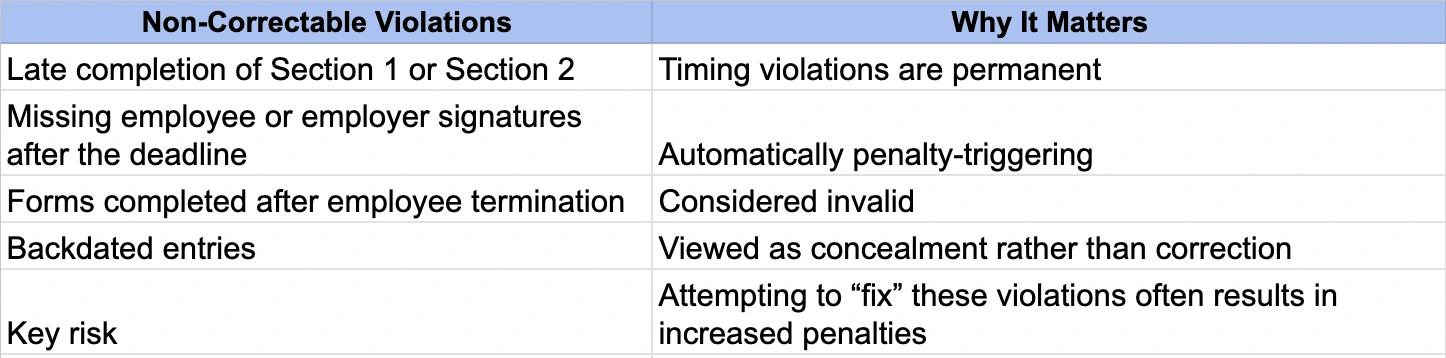
- Missing or late Section 1 or Section 2
- Missing employee or employer signatures
- Failure to complete the form at all
- Backdating or improper corrections
In prior enforcement actions, the majority of employer fines stemmed from substantive paperwork violations, not from knowingly employing unauthorized workers. This pattern holds across industries and company sizes.
Where audits most often fail employers
From real audits, ICE consistently flags:
- Forms completed after the 3-day deadline
- Inconsistent practices across locations
- Missing I-9s for long-tenured or terminated employees
- Poor document tracking during rehires and re-verification
The takeaway is straightforward: most audit risk lives in execution, not policy. Employers with written compliance policies still fail audits when teams follow different processes, rely on memory, or manage I-9s manually.
Audit readiness means assuming every field will be reviewed and building processes that can withstand that level of scrutiny.
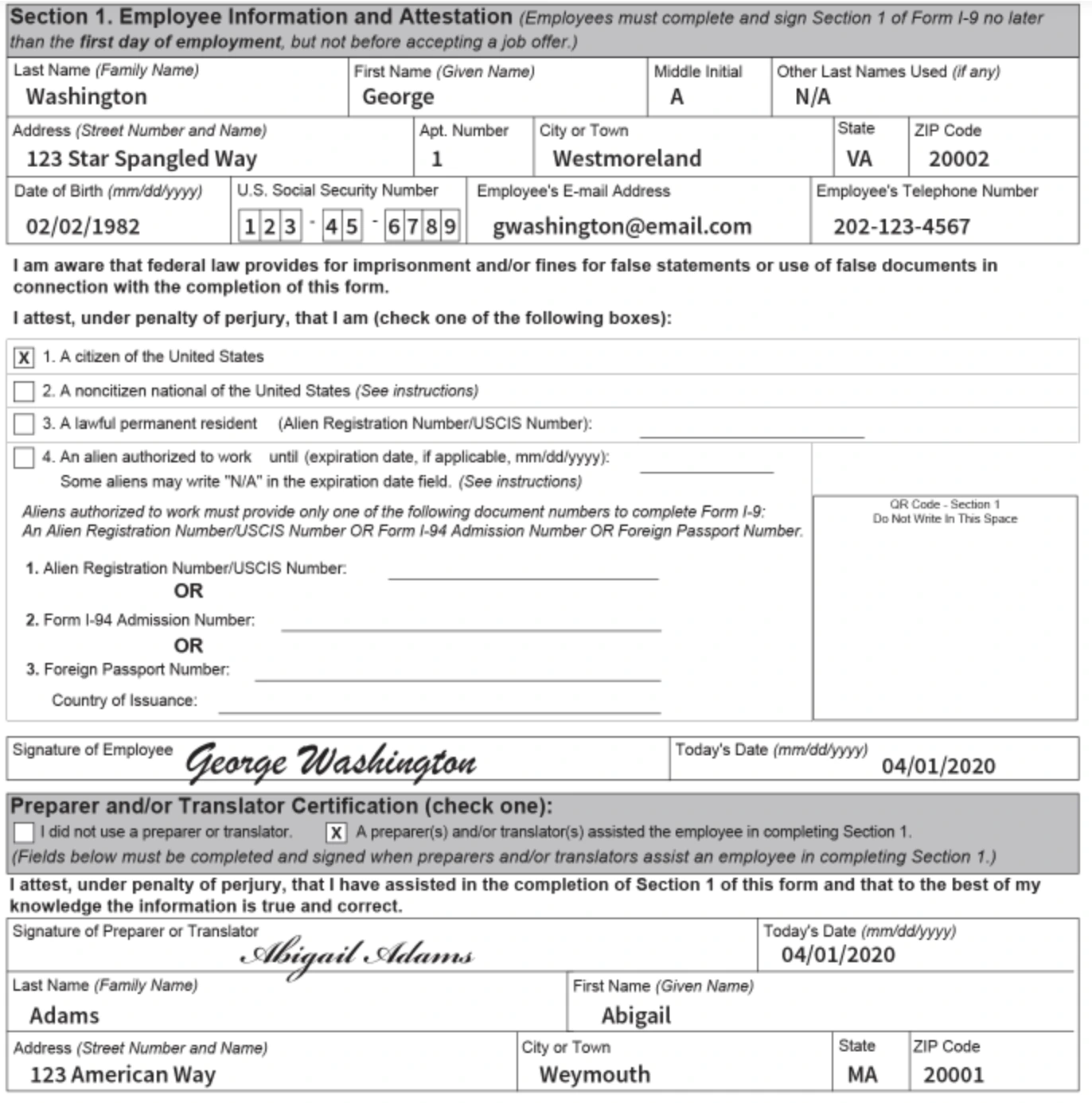
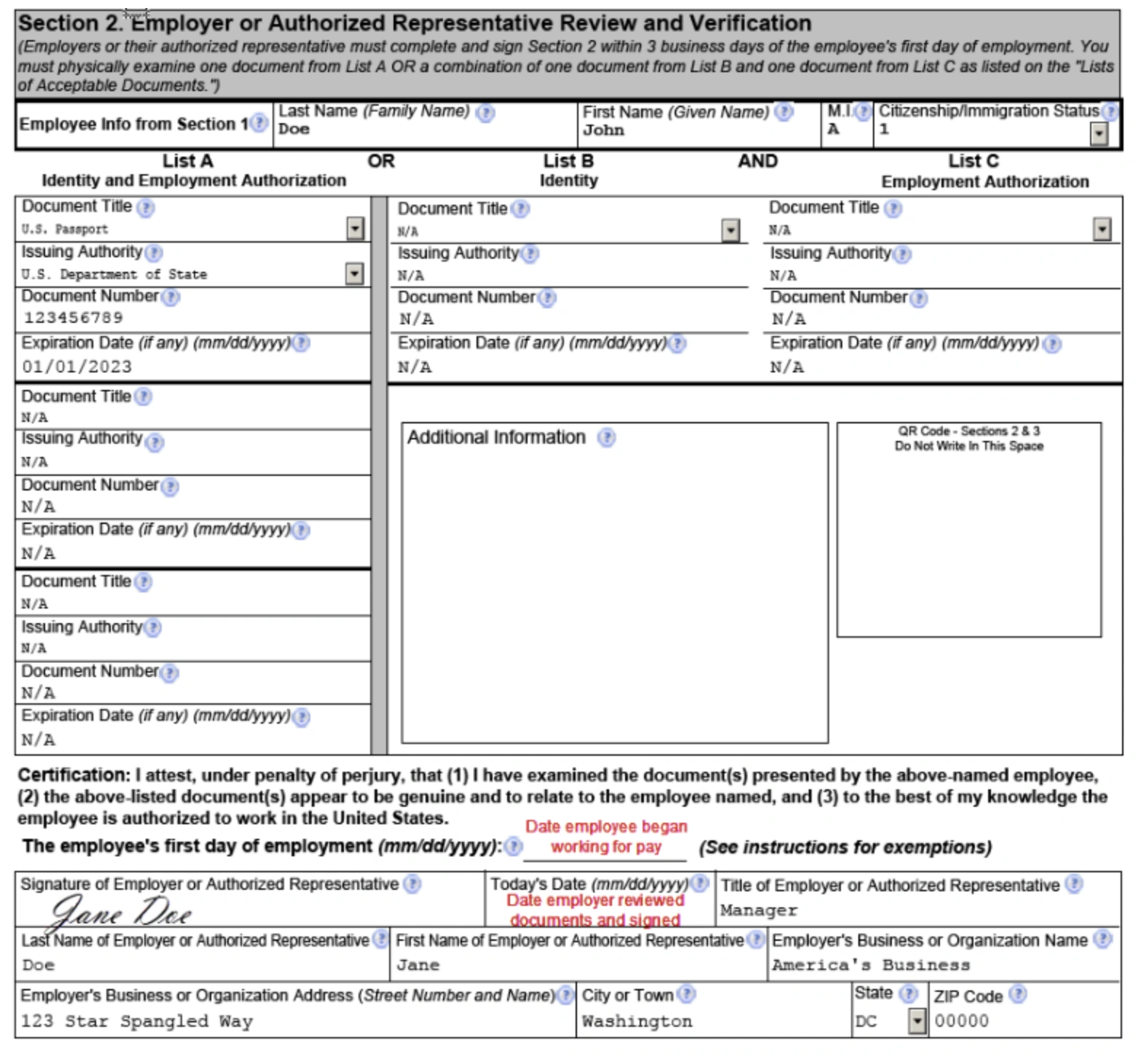
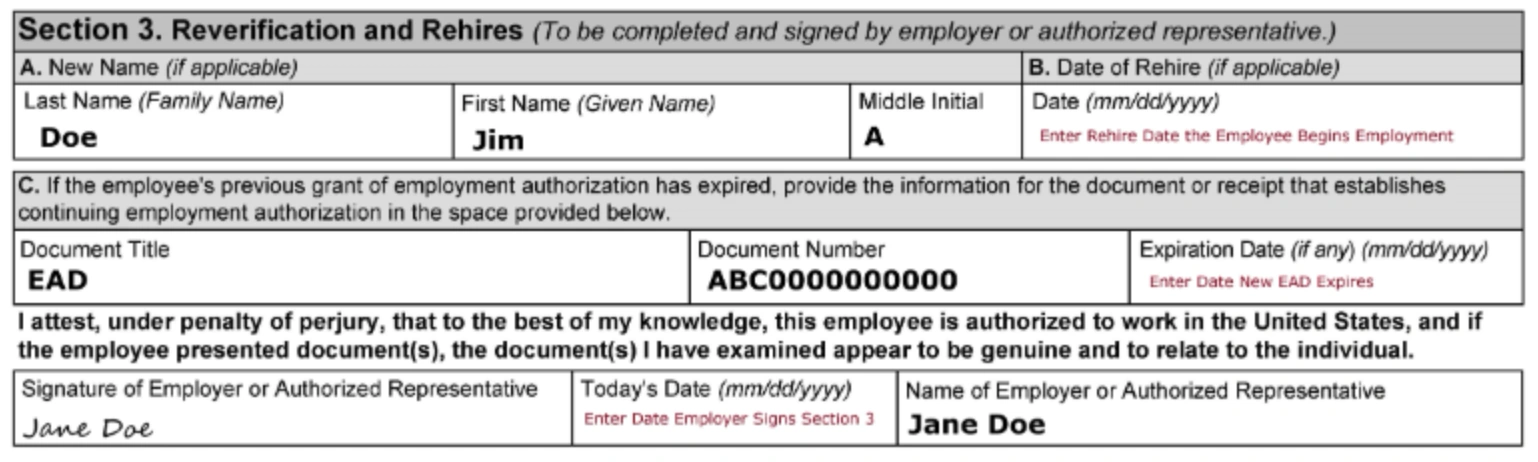
Examples of an I-9 Form Filled Out Correctly
Section 1
Section 2
Section 3
Understanding the 3-Day Rule and Other Critical I-9 Deadlines
Most I-9 violations stem from missed deadlines, not from incorrect documents. Auditors consistently flag timing errors because they are easy to verify and impossible to fix after the fact.
The 3-business-day rule
Employers must complete Section 2 of Form I-9 within three business days of an employee’s first day of work for pay. Day one is the first day the employee performs work, not the offer date or orientation, if work has already begun.
Common failures include treating the deadline as “three calendar days", missing deadlines due to weekends or holidays, or delaying completion for remote or off-site hires.
If Section 2 is late, the violation is substantive. ICE does not allow retroactive correction.
Section 1 timing errors
Employers often discover missing signatures, undated forms, and section 1 completed after day one. These errors are among the most frequently cited violations because they signal weak onboarding controls.
Re-verification deadlines
Employers must reverify an employee’s work authorization on or before the document’s expiration date, never after. Missed re-verifications usually stem from process gaps, not lack of awareness.
Expiration dates are often tracked manually, ownership is split or unclear between HR and managers, and follow-ups depend on spreadsheets or calendar reminders that are easy to overlook. From an audit perspective, a late re-verification carries the same compliance risk as a late initial I-9, with no allowance for retroactive correction.
Rehire timelines
For rehires, employers must complete a new I-9 or properly update Supplement B within the allowed rehire window. Auditors routinely flag rehire errors when employers reuse outdated forms or skip required updates.
Why deadlines drive audit outcomes
From audit experience, timing violations account for a significant share of penalties, even when all employees were authorized to work. ICE treats deadlines as a measure of process discipline. When employers miss them, auditors assume broader compliance gaps.
Audit-ready employers do not rely on memory or manual follow-ups. They build systems that enforce deadlines automatically because once a deadline passes, the risk is permanent.
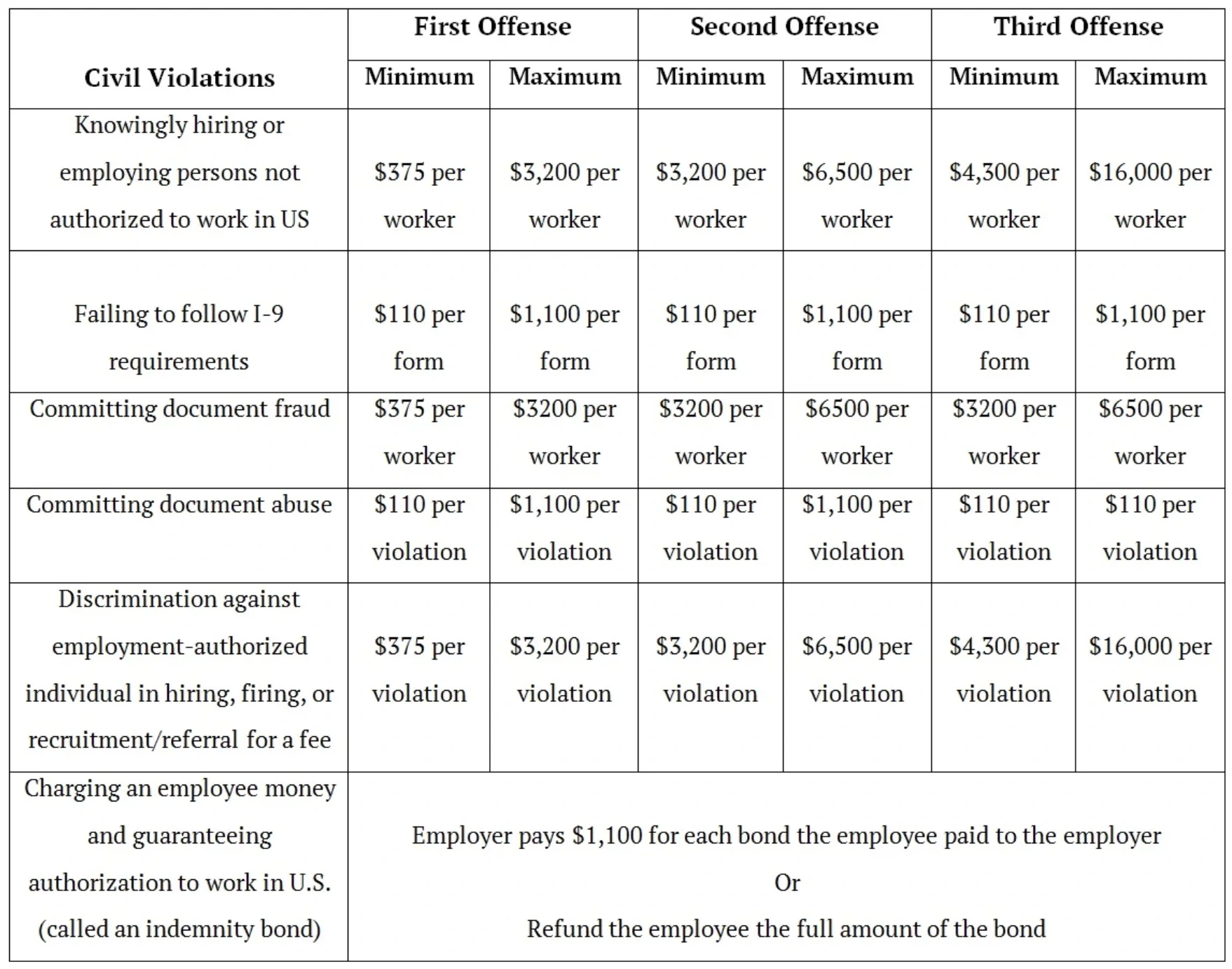
I-9 Audit Penalties in 2026: What’s at Stake for Employers
I-9 audits carry real financial and operational consequences, even when every employee is authorized to work. The ICE penalizes employers primarily for paperwork and process failures.
Civil fines for paperwork violations
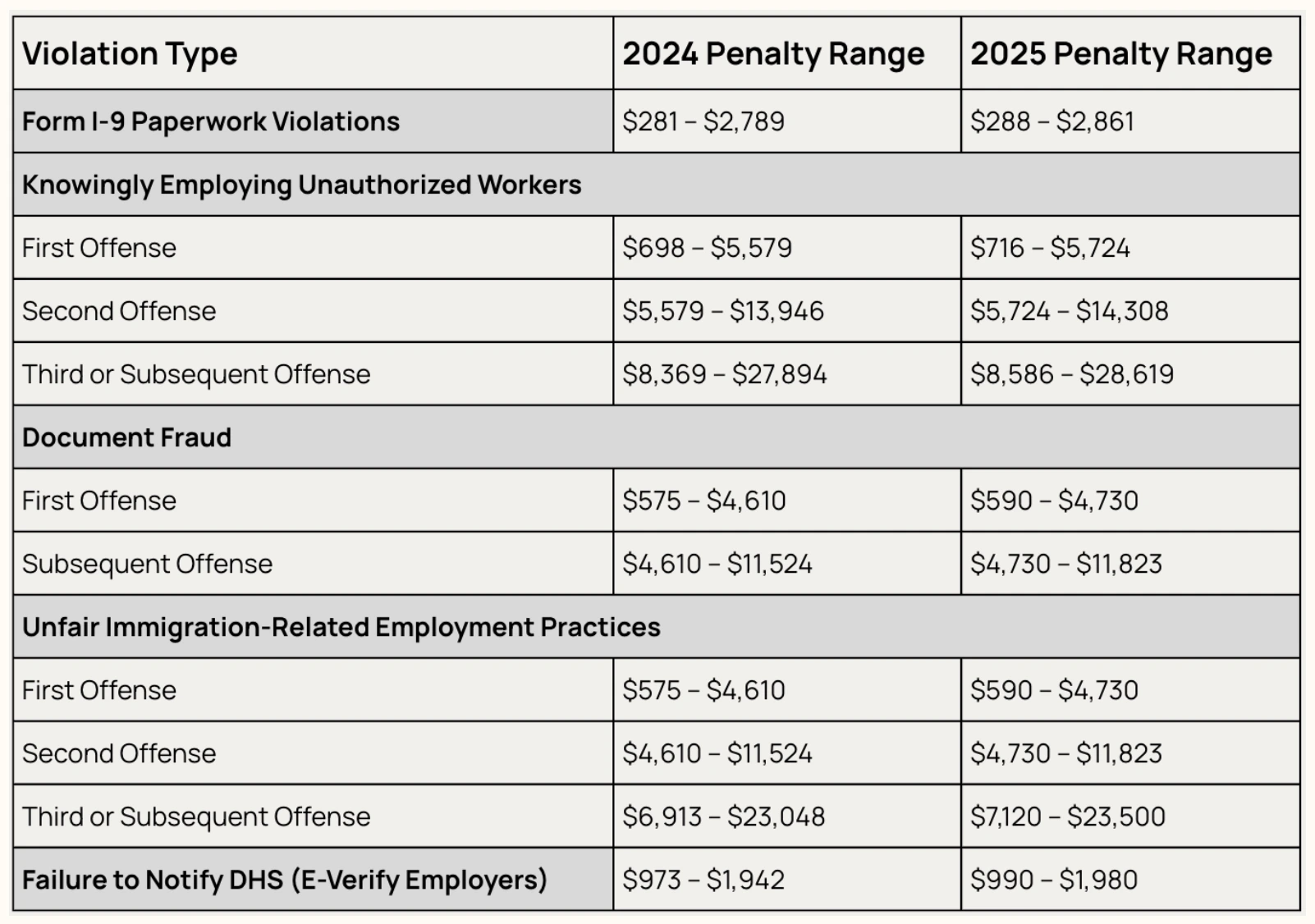
In 2026, penalties for Form I-9 violations typically fall into these ranges:
- Hundreds to several thousand dollars per form, depending on severity
- Penalties increase based on the percentage of forms with errors, not just the number of employees
- Repeat violations significantly escalate acceptable amounts
In past enforcement cycles, ICE has reported millions of dollars in annual fines, with the majority tied to technical and substantive I-9 errors, not unauthorized employment.
Factors that increase penalty exposure
Auditors consider the volume of errors across all forms, whether violations are technical or substantive, the history of prior violations, and evidence of good-faith compliance efforts.
Employers with inconsistent processes across locations or years often see higher penalties because errors compound quickly.
The hidden cost of an audit
Fines are only part of the impact. Audits also create significant HR and legal time costs, business disruption during document collection, and reputational risk with regulators and partners.
In practice, many employers underestimate total audit costs because they focus only on fines, not the internal drain of weeks of remediation and follow-up.
The key point is simple: penalties scale with process breakdowns. Employers who manage I-9s manually or reactively expose themselves to compounding risk. Audit-ready organizations reduce penalties not by luck, but by controlling execution long before ICE gets involved.
How I-9 Fines Are Calculated: Risk Factors Employers Overlook
Once penalties are on the table, the calculation follows a defined framework. ICE does not assess fines based on company size alone or on isolated mistakes. Instead, penalties scale based on patterns, violation rates, and evidence of process control.
The most important factor is the percentage of I-9s with violations, not the raw number of errors. A smaller employer with errors across a majority of its forms can face higher per-form penalties than a larger organization with a lower violation rate. Even a single missing or incorrect field counts toward that percentage, which is why seemingly minor mistakes compound quickly.
Violation type also matters. Technical violations may be reduced or eliminated if corrected within the allowed window. Substantive violations, however, automatically count toward penalties and cannot be corrected retroactively. Employers often assume they can address issues later; ICE’s framework does not allow for that assumption.
Beyond the forms themselves, ICE adjusts penalties based on broader compliance signals. Documented good-faith efforts, consistent processes, and clear ownership can mitigate fines. In contrast, inconsistent practices, missed deadlines, and fragmented record keeping increase exposure because they indicate systemic failure rather than isolated error.
The key insight: ICE penalizes systems, not just forms. Employers who rely on manual tracking or fragmented workflows expose themselves to compounding fines because every breakdown multiplies across hires. Audit-ready organizations reduce penalties by controlling the process, not by hoping errors stay small.
How to Conduct an Internal I-9 Self-Audit (Without Creating Risk)
An internal I-9 self-audit helps employers find and fix issues before an inspection, but only if it’s done correctly. Poorly executed self-audits often create more risk than they reduce.
When a self-audit makes sense
Employers should conduct I-9 self-audits before major hiring, after mergers, acquisitions, or system changes, and when management is decentralized. Waiting for an inspection notice severely limits the ability to correct I-9 deficiencies.
Who should be involved?
Limit participation to HR or compliance leaders familiar with I-9 requirements, and to a single, consistent reviewer or a small audit team.
Too many reviewers increase inconsistency and documentation risk. In complex situations, employers often involve counsel to preserve audit discipline and intent.
How to review forms safely
A proper self-audit focuses on missing forms, timing violations (late Section 1 or Section 2), missing signatures or dates, and reverification errors.
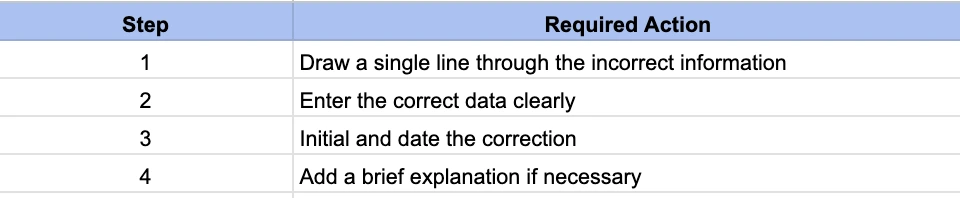
When reviewing I-9 forms, examine them in their current state. Avoid unnecessary actions like recreating, replacing, or "cleaning up" the forms. All modifications must be traceable and completely transparent.
Correcting issues without increasing exposure
In real audits, ICE often looks more favorably on employers who can show a structured, good-faith review process even when issues exist.
- Correct only what is legally correctable
- Annotate changes clearly with dates and initials
- Never backdate or conceal original entries
- Document your audit methodology and findings
The biggest self-audit mistake
The most common failure is treating a self-audit as a cleanup exercise instead of a risk assessment. Self-audits should identify process breakdowns, not just form errors.
Done right, a self-audit reduces exposure. Done casually, it creates new violations that did not previously exist.
Correcting I-9 Errors the Right Way
Correcting I-9 errors requires precision. Improper fixes often create new violations, which auditors treat more seriously than the original mistake. The ICE expects corrections to be transparent, limited, and clearly documented.
What can be corrected?
What cannot be corrected
How to make a compliant correction
It is advisable not to use white-out, erase entries, or replace the original form. The ICE expects to see the original mistake and the correction side by side.
Employee vs. employer corrections
Employees must correct errors in Section 1 and employers correct Section 2 and Supplement B. If an employee is no longer available, document why and correct only what is permitted.
The most common correction mistake
The most significant error employers make is overcorrecting, redoing entire forms or standardizing entries after the fact. Auditors view this as evidence of concealment, not compliance.
The rule is simple: correct only what is allowed, document everything, and never try to make the form look “perfect.” Clean records matter less than honest, traceable ones.
Remote and High-Volume Hiring: Where Audit Risk Increases
Remote and high-volume hiring exposes I-9 weaknesses faster than any other model. The issue is not eligibility; it’s execution at scale.
Remote hiring risks
Remote I-9 completion introduces more points of failure than automated workflows.
Document review is often delayed by scheduling issues or time zone differences, authorized representatives are used inconsistently, and remote verification steps are not always documented properly. When employers fail to provide clear, standardized instructions, authorized representatives frequently complete forms incorrectly.
In an audit, ICE places full responsibility for those errors on the employer regardless of who physically completed the form.
High-volume hiring risks
During rapid hiring periods, small process gaps escalate quickly. Section 2 deadlines are missed, forms are completed differently across teams, and quality checks are deprioritized to keep pace with demand.
In real audits, employers frequently find that error rates spike during peak hiring windows, which directly increases penalty exposure under ICE’s violation-rate model.
Multi-location inconsistency
Distributed hiring teams often operate without a single, consistent process. Onboarding timelines vary by location, instructions are interpreted differently, and forms are stored locally rather than in a central system.
Auditors view these inconsistencies as systemic failures, not isolated mistakes. Even when individual forms are technically correct, they lose credibility when the overall process lacks control and standardization.
Why these models fail audits
Remote and high-volume hiring break down during audits when employers depend on manual handoffs, email- and PDF-based workflows, and local knowledge instead of standardized processes. These approaches introduce inconsistency at scale and make errors inevitable.
Audit-ready employers design I-9 workflows that function the same way everywhere, regardless of location or hiring volume. Without that level of consistency, scale turns from a growth advantage into a compliance risk.
What Happens After an I-9 Audit: ICE Notices Explained
After reviewing your records, ICE issues formal notices that determine your next steps. These notices are not advisory; they carry legal and financial consequences.
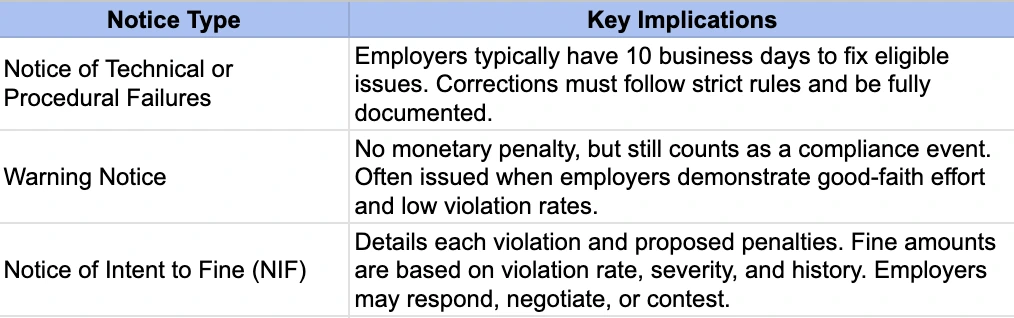
Other possible notices
- Notice of Discrepancies: Issues found that may involve work authorization mismatches
- Notice of Suspect Documents: Indicates potential authorization concerns requiring follow-up.
These notices trigger additional employer obligations and strict response timelines.
Why this stage matters
From audit experience, employers often underestimate how quickly audits escalate after review. Missed deadlines, incomplete responses, or inconsistent explanations during this phase usually result in higher fines and expanded enforcement.
Once notices are issued, flexibility decreases. Employers who enter this stage without documented processes and clean records have limited leverage. Audit readiness determines outcomes long before these notices arrive.
Responding to I-9 Violations: Contest, Settle, or Remediate
Once violations are identified, employers must deliberate. At this stage, the goal is no longer readiness; it is risk control.
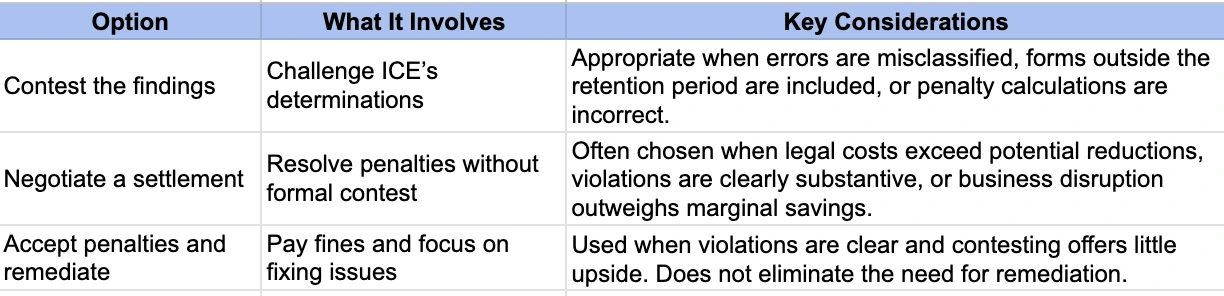
Immediate remediation expectations
Regardless of the path chosen, ICE expects employers to:
- Correct all fixable technical violations
- Address process gaps that caused the errors
- Prevent recurrence going forward
Failure to remediate increases exposure in future audits.
The mistake employers make here
The most common error is treating violations as a one-time event. Employers that pay fines without fixing underlying processes often face higher penalties in subsequent audits.
At this stage, decisions should be based on documented facts, not assumptions. Employers who understand their records, error patterns, and process gaps retain control. Those who don’t are forced into reactive outcomes.
Remediation After an I-9 Audit: Fixing Gaps and Preventing Repeat Issues
An audit outcome is not the end of enforcement exposure. How employers remediate after an audit directly affects future penalties, scrutiny, and credibility.
What ICE expects after an audit
Following an inspection, ICE expects employers to take corrective action that goes beyond the forms themselves. Eligible technical violations must be corrected within the required timelines, but that alone is not enough. Employers are also expected to address the underlying causes that led to the violations and implement controls that prevent the same issues from recurring. Paying fines without fixing broken processes signals ongoing compliance risk and increases exposure in future audits.
Focus remediation on systems, not forms
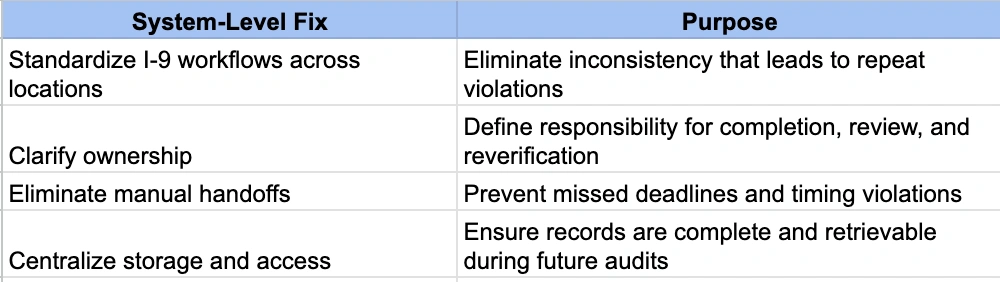
Training and accountability
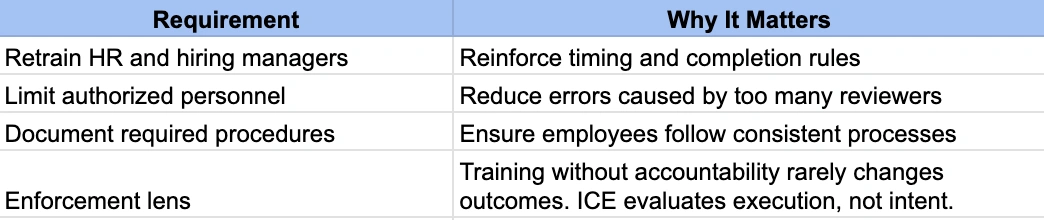
Document remediation efforts
Employers should retain written process updates, training records and evidence of internal reviews or controls. These records help demonstrate good-faith compliance in future audits and can mitigate penalties if issues resurface.
The long-term risk of incomplete remediation
From enforcement experience, employers that fail to remediate thoroughly often face repeat audits within a few years, with less flexibility and higher fines. ICE treats repeat violations as evidence of systemic neglect.
Remediation is the process by which audit outcomes are determined in the long term. Employers who fix processes reduce future exposure. Those that don’t convert a single audit into an ongoing compliance risk.
Building an Audit-Ready I-9 Process for 2026 and Beyond
Audit readiness is no longer a periodic exercise. In 2026, employers that pass audits consistently treat I-9 compliance as an operational system rather than a form requirement.
Why legacy approaches fail
Manual and semi-manual I-9 processes break down because they rely on human memory for deadlines, local interpretation of rules, and disconnected storage across teams and locations.
These gaps don’t show up immediately. They surface during audits when it’s too late to fix them.
In real audits, employers with decentralized or spreadsheet-based tracking show higher violation rates, even when their hiring volume is moderate.
What “audit-ready by default” looks like
Audit-ready employers share a few characteristics:
- Standardize I-9 workflows across all hiring scenarios
- Clear ownership for completion, review, and re-verification
- Centralized records that can be produced quickly
- Built-in controls that enforce deadlines automatically
The key shift is removing discretion from critical steps. When timing and completeness depend on individuals, errors scale with growth.
The takeaway is simple: audits punish fragmentation. Employers who treat I-9 compliance as a living process, not a hiring checklist, enter audits with control, credibility, and far less risk.
In 2026, the employers who pass audits with minimal disruption are not the ones who scramble when an inspection begins. They are the ones who built processes that hold up long before an auditor asks for records.
If you want to see how FirstWork supports audit-ready I-9 compliance in high-volume, distributed hiring environments, book a demo today.
Book a demo with Firstwork